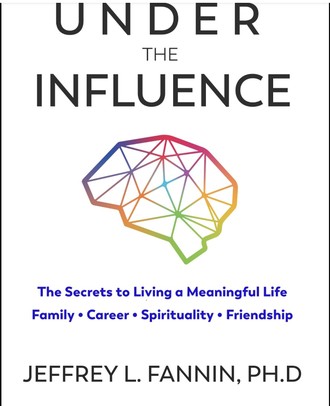
Under The Influence
What's valuable. Five ideas worth keeping, and a first-person account of a stroke that is genuinely hard to read. A man in his late sixties wakes on his bathroom floor in a pool of his own blood, finds he cannot make his mouth say the words that are perfectly clear in his head, and rings the emergency services anyway. That passage, and the parable of the escalating messenger that follows it, are the reasons to open this book.
What you can take from it.
- The messenger gets louder — small warnings ignored become large ones. Ask what a problem is telling you the first time, not the fourth.
- Your mind invents a reason, then obeys it — when it cannot explain something it fabricates an explanation, and repetition turns the fabrication into a rule you live by.
- "If you are willing to accept any grade, why not a D?" — the standard you tolerate, not the one you aspire to, is the one you get.
- A feeling is a reading, not a problem — treat an unpleasant emotion as information about direction before treating it as something to fix.
- Information does not change anyone — the author's own record is that thousands of people he advised went back to exactly what they were doing.
What to know before you take any of it. From chapter five the book recommends three network-marketing products inside its case studies, and no commercial interest is disclosed either way — none is alleged here. Two of its set-piece passages reproduce other people's work without naming them; whether that was intended is unknown and unknowable. The five ideas above are all available, better argued and properly sourced, elsewhere — and this note says where.
Why it still helps people. The framework underneath this book is the law of attraction, and it has no evidential support as a mechanism. That is a finding about the explanation, not about whether the practice does anything — a great many people follow it and report real benefit, and there are well-evidenced reasons why: expectancy and placebo effects, selective attention, self-efficacy, and the fact that the practices smuggle in doing things differently. If this book helped you, that is not naivety. The effect is real; the explanation offered for it is not.
How it scores.
✓ HOLDS UP a real strength ▲ CARE works, with a catch ✕ FAILS doesn't stand up i CONTEXT neither good nor bad
| ✕ FAILS | Is the explanation proven? | The stated mechanism — that your emotional state broadcasts a frequency which attracts matching events — is framed so that no result could contradict it. Good outcome: you were aligned. Bad outcome: you were misaligned without knowing. An unfalsifiable claim is a weaker thing than an untested one. Three references exist in the whole book. |
| ✓ HOLDS UP | Do people report it works? | Yes, in very large numbers, and that is a separate question from the one above. Expectancy and placebo effects, selective attention, self-efficacy and behavioural activation are all well evidenced, and all are present in the practice. Unevidenced is not useless. The mechanism being wrong does not make the reported benefit imaginary. |
| ✕ FAILS | Has anyone actually used it and reported back? | One case is reported in detail: a teenager whose test scores improved. The author's own endnote reveals the boy was simultaneously given a biofeedback device, a tutor and repeated practice tests — none of which the chapter mentions. |
| ✕ FAILS | How many people tried it, and how many did it work for? | Nobody counted. The book offers volume instead — 4,000 people mapped, five years travelling, thousands of consultations — but no outcome is ever tallied. A count of encounters is not a count of results. |
| ✕ FAILS | Can you tell the useful part from the sales pitch? | No, and this is the book's central failure. Three commercial products are recommended inside case studies, in the same voice as the ideas, with no interest disclosed. Every chapter ends with a link to the author's coaching. |
| ▲ CARE | What's the best argument against it? | No published critique of the book exists. The strongest adjacent one is an investigation into the supplement company whose products fill chapter five — thin, mixed human evidence and a regulator's warning letter. Harm is possible here: the doctrine tells sick people their illness reflects their own emotional state. |
| ✓ HOLDS UP | Could you actually do it? | The four usable ideas cost nothing and need no equipment, no partner and no daily slot. Noticing that your mind has invented a reason is free. |
| ✓ HOLDS UP | If you stopped, how hard is it to start again? | Entirely forgiving. Nothing here punishes a gap, because nothing here accumulates. |
| i CONTEXT | How much would actually change if you used it? | Nothing at all — a thermometer, not a treatment. At best it gives you a way of noticing your own reactions. The book presents itself as replacement-scale change; it is not. |
The Five Ideas
| 01 | THE MESSENGER GETS LOUDER | Ignore a small warning and you get a bigger one. |
| 02 | THE MIND MAKES IT UP | It invents a reason, then obeys the invention. |
| 03 | WHY NOT A D? | You get the standard you tolerate. |
| 04 | THE FEELING IS A READING | Emotion as instrument, not as problem. |
| 05 | INFORMATION CHANGES NOBODY | Words don't teach. Consequences do. |
From the book
"I woke up on the bathroom floor in a puddle of blood! My face had hit the tile floor when I passed out and fell off the toilet... I tried to speak. Even though the words I was trying to speak from inside my head were coming out as mumbles from my mouth. Stark terror hit as I realized I had a stroke."
The author is a psychologist who spent nearly three decades doing quantitative EEG brain mapping. In June 2019 he had a stroke, alone, at home. The book is his attempt to turn that — and a second stroke, an eviction and the loss of everything he owned — into a set of principles for living a meaningful life.
It was picked up as a test of whether a book can be worth reading when its framework is wrong. The answer turned out to be more interesting than expected, and it is not a comfortable one.
01 · The Messenger Gets Louder
"The messenger has a job to do...that is, deliver a message to you, but you won't pay attention... The messenger bends down and picks up a big rock and heaves it through your window. You hear the glass shatter, but you are too busy... The messenger is getting frustrated notices some dry brush around the bottom of the house and sets it on fire."
You are at home. The doorbell rings; someone has a message for you. You say thank you and shut the door. It rings again — you ignore it. He goes round the back and knocks; you are too busy to walk over. He throws a rock through your window. You carry on. He sets fire to the brush at the base of the house.
You run outside and ask him why he set fire to your house. "I tried every other way to get your attention."
This is the best thing in the book, and it works entirely on its own.
What makes it more than a fable is that it describes a real pattern in how problems arrive. Almost nothing that eventually goes badly wrong gives no warning at all. It gives a small, cheap, easily-ignored warning first — the one that would have cost an afternoon to deal with. Then a more expensive one. Then the one you cannot ignore, which by then costs everything.
The question is never "why did this happen to me". It is "at which knock did I stop listening".
The four questions he attaches to it are worth keeping: what does this mean, why am I getting it, how did my own behaviour contribute, and what am I willing to do about it. The third is the one people skip.
02 · The Mind Makes It Up
"My conscious mind quickly makes up something to fit the situation. 'Why did they do that?' My brain to makes up stories and begins fill in the blanks so the situation can make sense of why they did that... We can't be mad at the brain. It's just doing its job... If it is confused our uncertain about something it will make up an answer."
Someone cuts you up on the motorway and you brake hard. Within a second your mind has supplied a reason — he's rushing to hospital, he's late for a flight, he's an idiot. You did not choose the explanation and you have no evidence for it.
That much is ordinary. The useful part is what he says happens next: repeat the thought and "it gets recorded in the subconscious as a RULE. Now that rule we created from our perception will guide and direct our behavior forever...unless we change it."
His illustration of it is the clearest writing in the book. A song you loved during a relationship makes you feel good. The relationship ends and the same song now feels bad — the meaning attached to it has been rewritten. Years later you are walking through a shopping centre, not consciously listening to anything, and you feel low without knowing why.
You did not notice the song. Something in you did.
The transferable claim is narrow and worth stating precisely: you are not usually reacting to events, you are reacting to an explanation of events that you invented and then forgot inventing. The gap between those two is where most avoidable arguments live.
03 · Why Not a D?
"I stood nervously in front of my Psychology teacher, Mrs. Sullivan, trying to muster the courage to ask, 'Why did you give me a "D" I did everything you asked of me. I did every assignment, attended every class.'... She said, 'If you are willing to accept any grade, why not a D?'"
He is in his first year of secondary school. He has never had a bad mark. The mid-term envelope, meant for his parents, contains a D. He goes to the teacher to ask why, and gets that answer.
Then she hands him a second envelope. His real grade is an A.
The lesson lands because of what he admits about himself: "School has always been easy for me. The teachers never challenged me. I was just coasting... I didn't know I was coasting."
That is the whole idea. Coasting is invisible from the inside. If the work is comfortably within reach, nothing in the day tells you that you are operating well below what you could do — the results keep coming, everyone seems satisfied, and the absence of struggle reads as competence rather than as a warning.
A person accepting far less than they could do usually feels fine. That is the problem with it.
It is also a small masterclass in how to correct someone. She did not tell him he was coasting; he would have disagreed. She created a situation in which he came to her and asked the question himself.
04 · The Feeling Is a Reading
"When you feel negative emotion your personal guidance system is telling you that you are generating a vibrational output that will not bring you a pleasurable result."
Strip the vocabulary out and something usable remains.
Most people treat an unpleasant feeling as a problem to be solved, suppressed or justified. The alternative proposed here is to treat it first as information about direction — a reading on a dial rather than an event in itself. Before asking "how do I stop feeling this", ask "what is this telling me about where I am pointed".
The practical form is a ladder. He arranges emotions from heaviest to lightest — depression, revenge, anger, blame, worry, doubt, disappointment, frustration, boredom, contentment, hope, optimism, enthusiasm, joy — and the claim is not that you leap from the bottom to the top, but that you can usually move one rung. Someone stuck in despair can often reach anger, and anger is a better place to act from.
You are not trying to feel good. You are trying to move one step and see whether the view changes.
Two honest caveats, because this idea is the one most likely to do damage. First, it is not the author's; it comes almost word for word from a body of work he never names, and that matters, because the original makes a more modest claim than the one made here. Second, this framing is genuinely harmful when it is turned into a theory of causation — the version that says your feelings cause your circumstances. Kept as a way of noticing, it is useful. Extended into a law about how the world works, it becomes the thing criticised at the bottom of this note.
05 · Information Changes Nobody
"I have spent 28-years of my life doing thousands of brainmaps. Having thousands of consultations with people about their brain, how it works and why we do the things we do. Yet, a few weeks after these consultations I had with them, many people walk right back into their box and continue to live their life as if all that made up crap they unintentionally made up is true!"
He means this as a complaint about other people. It is better read as the most valuable admission in the book.
A man spends twenty-eight years explaining to people, individually, with a picture of their own brain in front of them, exactly what is wrong and what to do about it — and reports that most of them are unchanged a few weeks later.
That is not a fact about their stubbornness. It is a fact about explanation.
He states the principle himself, twice: "it is experience that teaches us, not the words we read, the talk we listen to, or even the videos that we watch", and "words don't teach us, experience does!"
Nothing he wrote changed him either. A stroke did.
That is the honest and uncomfortable core of this book. Everything he needed to know, he already knew and had taught to thousands of people. It made no difference to his own conduct until the consequence arrived and could not be argued with.
If you take one thing from these pages, take this: when you want someone to change — including yourself — providing more information is almost always the least effective thing available, and it is almost always the first thing tried.
Also in the book, and nearly made the five
Neurofeedback, explained properly (ch 5). The clearest passage of technical writing in the book. A child wears a cap of electrodes and simply watches a film; when their brain activity drifts outside a set window, the film briefly interrupts with a tone. Nobody instructs the child, and nothing is demanded of them. "As smart as the brain is, it would quickly learn to compensate." It describes a real, established technique in a way anyone could follow — and the book then sets it aside in favour of supplements.
Fog as a model for a threshold (ch 6). When air temperature and dew point are three degrees apart there is no fog. Close them to two and fog appears everywhere at once. A good image for any system where nothing visibly happens and then everything does — and for why people mistake the moment they noticed a change for the moment it began.
Steering in rough water (ch 8). "Anyone can guide the ship in calm water." Ordinary, but he puts a useful edge on it: the sea is calm only occasionally and briefly, so the skill worth building is not for the exception but for the normal condition.
His own concession about measurement (ch 1). "Even among researchers, there is little consensus about the best way to measure what brings human beings' satisfaction and fulfillment." A genuinely honest line, and one the rest of the book proceeds as though it had not written.
The doubts, and the case against
The doubt against each idea
01 · The messenger gets louder. Reads backwards far too easily. Warnings genuinely do escalate — but plenty of catastrophes arrive without any prior knock at all, and the parable has no way to say so. Applied after the fact it becomes a machine for finding your own fault in a stroke, a redundancy or a bereavement. Useful facing forwards; cruel facing backwards.
02 · The mind makes it up. The idea is sound and close to well-established work on confabulation and conditioning. What is not established is the mechanism he attaches to it — that a memory is "bound together" by a specific neurotransmitter, stated as fact with nothing behind it. Take the observation; leave the biochemistry.
03 · Why not a D? The weakest thing about it is that it is a single anecdote about a bright, well-supported teenager, recalled sixty years later. The advice does not generalise safely: for someone who is struggling rather than coasting, being handed a false D by a trusted adult would be simply cruel. The teacher's skill was knowing which pupil she had.
04 · The feeling is a reading. Beyond the caveats above, the ladder itself is presented as though the ordering were a measured property of emotions. It is not. It is a plausible arrangement, and no evidence is offered that boredom sits above frustration in any way that could be tested.
05 · Information changes nobody. He reports the failure and then does not follow it anywhere. His response to discovering that consultations do not change behaviour is to sell more consultations. The insight is real; the book is a live demonstration of not acting on it.
The case against — no published critique exists, so here is the nearest real one
No substantive published critique of this book was found. Searching returns the author's own promotional material, podcast appearances and retail listings, and nothing else. That is a finding about the book's standing rather than a gap in the research: it is self-published, and nobody has engaged with it critically because very few people have read it.
The strongest real, named, published criticism bearing on the book's core is not about the book. It is Lindsay Gellman's investigation "How a supplement company became a haven for health misinformation" (STAT News, 8 September 2023) into LifeVantage, the network-marketing company behind two of the three products this book recommends. Her findings: the human evidence is thin and mixed — a 2005 study of 29 adults with no placebo control, a 2016 study of 38 runners which found the supplement improved neither performance nor oxidative-stress markers. The mouse result was a 7% increase in male median lifespan, "small but statistically significant". Paul Coates, former director of the National Institutes of Health Office of Dietary Supplements, is quoted: "The claims are not supportable by this kind of study." The Food and Drug Administration issued the company a warning letter in April 2017 over disease claims.
Where that critic is vulnerable, stated fairly. Gellman is writing about a company and its distributor network. She never mentions this author, and nothing in her piece establishes anything about his conduct or his sincerity. It bears on the book only because one chapter's entire evidential payload is that company's products.
And where the book supplies the evidence against itself — which is the strongest form this takes, and it happens four times.
- It reproduces, at length, the case against its own thesis. In the middle of arguing for mind-to-mind connection, the book sets out the sceptical literature in detail and then simply moves on. Two celebrated Victorian "thought readers" who both denied having any psychic ability and attributed their feats to reading muscular tension; a 1979 physics investigation whose authors concluded their results were "a strong argument against the validity of telepathy"; a 1996 study in which believers overestimated their successes while sceptics judged accurately; and a 2002 study explained by hindsight and confirmation bias — followed by a textbook definition of confirmation bias. Nothing in the book answers any of it.
- Its own endnote dismantles its own case study. Chapter five presents a teenager's improvement as evidence for three supplements over twelve days. The endnote to that chapter adds that he was also using a biofeedback device twice daily, and working with a tutor, and taking repeated practice tests. None of that appears in the chapter.
- It states the homeopathic principle outright. Describing a device it recommends: "The finished product has been diluted to the point that the herb can no longer be detected in the liquid, but energy of the herb is transferred to the liquid. This finished homeopathic is often more powerful and effective that the original herb."
- It offers a video as proof. On the feats it builds a chapter around: "If you don't believe me, look it up on YouTube and see it for yourself."
What this note cannot claim. No commercial relationship between the author and any of the three companies whose products he recommends has been established — only that the products are named and promoted, that the book carries a distributor call-to-action and a supplement-marketing disclaimer, and that no interest is disclosed. The absence of disclosure is the finding; a financial arrangement is not alleged. Separately, the unattributed passages were identified by comparison against the original sources rather than by any formal analysis, and the author's intent is unknown — nothing here establishes whether the omissions were deliberate.
And the part a reader meets on the page
Three things, and the second is the serious one.
The sourcing. Two of the book's set-piece passages are other people's work, uncredited. The final chapter's climax — its argument about purpose and significance, the study in which students photographed what made their lives meaningful, the tractor, the caretaker who says he is proud of his job, and the closing question "Can we give meaning away?" — is a near-verbatim reproduction of an academic's public lecture, ending, in the book, with the word "Thank you." A long explainer on stem cells is a medical charity's patient-education page, reproduced down to its pronunciation guide. Neither source is named anywhere. A third body of material — the entire emotional-ladder framework the book's practical advice rests on — comes almost term for term from a well-known body of channelled New Age writing, also unnamed. In fairness, one major source, a large public opinion survey, is credited, though only in an endnote and never in the text that uses it for several pages.
The commerce. From chapter five onwards the book recommends three products — two supplements and a scanning device, then a light-therapy patch — inside case studies, in the same voice as the ideas, with no interest declared. One chapter still contains the phrase "contact your distributor." Every chapter ends with a link to the author's own coaching, blog or paid mastermind group. A reader is never told where the argument stops and the sales begin, and by the second half there is no meaningful distinction.
The blame. The book's doctrine is that you attract what happens to you. Applied to a scratched car in a supermarket car park it is merely silly — "there is no one to blame but ourselves". Applied where the author applies it, it is something else. He attributes his second stroke, the failure of a water pipe installed by a previous tenant, his landlord's decision, a national housing market, and a storage company auctioning every possession he owned including his doctoral gown, to his own emotional state. He had already recorded the medical explanation two paragraphs earlier: high blood pressure, after a period of acute stress.
He does not exempt himself, and that is the most honest thing about it. It is also the clearest possible demonstration of what is wrong with it.
There is a real person in this book having a genuinely terrible few years, alone, and explaining to himself that he caused it. Whatever else that is, it is not a secret to living a meaningful life.
A quieter fourth thing. One chapter takes its epigraph from a public figure best known for conspiracy theories, quoted approvingly and without remark. A reader is entitled to weigh that.
Open questions
- Does the author hold a commercial relationship with any of the three companies whose products he recommends? The book neither discloses nor denies one. It is checkable, and it would sharpen the verdict either way.
- Are the sources reproduced without attribution credited in any later edition, and did any of them ever raise it? How the omissions came about is unknown, and nothing in this note establishes it. The book is self-published, and self-published books are revised quietly.
- The claim that a specific supplement regime produced a visible change in quantitative EEG within twelve days is testable. Has anyone attempted it with a control?
- What happened to the teenager? The book says he finished his first year at university. That is one of the very few checkable outcome claims in it.
- Is there a version of the emotional-ladder idea that has actually been tested? The underlying observation — that people can usually move one step but not ten — sounds researchable, and the note could not find whether anyone has.
Where these ideas go next
The escalating-messenger parable belongs with the literature on warning signals and near-misses — the study of how organisations ignore small anomalies until a large one arrives. Charles Perrow's Normal Accidents and Diane Vaughan's work on the Challenger launch decision are the serious versions of the same observation, and they replace the moral framing with an institutional one.
The mind-invents-a-reason idea leads directly to work on confabulation, and to Daniel Kahneman's account of how quickly and confidently the mind supplies a coherent story from insufficient evidence.
The claim that information does not change behaviour is the one worth chasing hardest. It runs into the whole literature on behaviour change, where the finding that education alone barely moves conduct is old, robust and repeatedly rediscovered.
And the book's framework has an ancestor worth knowing: the emotional ladder and its vocabulary descend from twentieth-century New Thought writing, which is where the modern law-of-attraction genre begins. Reading the ancestor is more rewarding than reading the descendants.
If you liked this
- Michael Steger's public lecture on what makes life meaningful — the actual source of this book's best closing argument, given by the researcher who did the work, in about eighteen minutes.
- Daniel Kahneman, Thinking, Fast and Slow — the rigorous version of idea two, and a demonstration of what it looks like when someone shows their evidence.
- Barbara Ehrenreich, Smile or Die (published in the United States as Bright-sided) — the strongest sustained argument against exactly the doctrine this book teaches, written by someone who met it while being treated for cancer.
- Norman Doidge, The Brain That Changes Itself — popular neuroscience about genuine recovery and rewiring, sourced, and with the case studies named.
Sources
- Fannin, Jeffrey L. Under The Influence: The Secrets of Living a Meaningful Life — Family, Career, Spirituality, and Friends. Self-published, 2022. 216 pages. Read in full from the author's ebook edition.
- Pew Research Center, Where Americans Find Meaning in Life, 20 November 2018 — the source of the book's survey chapter. Open-ended survey 14–28 September 2017 (n=4,867); closed-ended 4–18 December 2017 (n=4,729).
- Michael F. Steger, What Makes Life Meaningful?, TEDxCSU — compared against the book's final chapter.
- Mayo Clinic, Stem cells: What they are and what they do — compared against the book's chapter seven.
- Quote Investigator, entry on "Everything is energy and that's all there is to it" — traces the attributed Einstein epigraph to Darryl Anka, 1996.
- Lindsay Gellman, "How a supplement company became a haven for health misinformation", STAT News, 8 September 2023 — used for the case against.
- The Ultimate Quotable Einstein, Princeton University Press — used to check the attributed Einstein quotations, none of which appear in it.